Gastrointestinal (GI) Cancers


Your Partner in the Journey Against GI Cancer
Our experienced and compassionate specialists are here to guide you through every step of your journey. From diagnosis through treatment and beyond, we work alongside you to create a care plan tailored to your needs. With access to the latest therapies and clinical trials close to home, we strive to make your treatment experience as seamless and supportive as possible.
Gastrointestinal Cancer Frequently Asked Questions
Gastrointestinal cancers can sometimes spread, or metastasize, beyond their original location. Common areas where this may occur include the lymph nodes, lungs, bones, peritoneum (the lining of the abdominal cavity), and, in some cases, the brain. Certain types, like colorectal and pancreatic cancers, can spread to the liver.
Understanding where the cancer has spread is important because it can influence the symptoms you experience and guide your treatment plan. Our team at RMCC carefully evaluates the extent of metastasis to ensure your care is tailored to meet your needs.
“GI cancer” is not a single disease, but a group of cancers along the digestive tract. That means treatment is highly individualized. Our experienced GI oncology specialists at RMCC will consider many factors, including cancer type and stage, biomarker test results, and overall health to design the most effective treatment strategy.
Treatment options may include:
- Surgery: Often part of a treatment plan, surgery aims to remove the tumor.
- Chemotherapy: This therapy targets and destroys cancer cells. While it can also affect some healthy cells, it’s a proven method for controlling cancer growth.
- Radiation therapy: Radiation can shrink tumors before surgery or target remaining cancer cells after surgery.
- Targeted therapy: These innovative drugs target specific genetic mutations or proteins that drive cancer growth.
- Immunotherapy: This treatment harnesses your body’s own immune system to fight cancer, using either natural or lab-made substances.
At RMCC, we are committed to providing you with the most comprehensive GI cancer care. Our specialists work together to create a personalized treatment plan designed around your unique needs and goals, helping you feel supported and informed every step of the way.
Biomarker testing helps identify specific genes, proteins, and other substances that may be influencing the growth of your GI cancer. At RMCC, we offer biomarker testing for a variety of GI cancers.
If a biomarker is detected in your tumor, it may open the door to targeted therapies—treatments designed to attack cancer more precisely. Your oncologist will review the results with you and explain how they fit into your overall treatment plan.
Our financial counselors work closely with you to review your insurance coverage for cancer care. They’ll help you understand what’s included and what out-of-pocket expenses you might incur. Choosing care at an independent cancer center like RMCC can make treatment more affordable, sometimes reducing costs by up to 50% — compared with hospital outpatient departments, according to the Community Oncology Alliance.
Affordable cancer care doesn’t mean compromising on quality. At RMCC, you will receive the same high standard of treatment as hospital-affiliated oncology departments, with advanced technologies and personalized care designed for your unique needs.
Clinical trials offer an exciting opportunity to access new treatments for GI cancers that aren’t yet widely available. At RMCC, we participate in several cancer clinical trials, giving people with GI cancer the chance to explore innovative therapies. While not everyone may qualify, we are happy to review your options, discuss eligibility, and make recommendations. Talk with your oncologist to determine whether a trial may be right for you.
RMCC has been at the forefront of cancer care across Colorado for more than 30 years. Our physicians and advanced practice providers trained at some of the most renowned cancer centers in the nation and beyond, bringing that expertise directly to you. They are focused on providing the most effective treatment options and tailoring care plans to meet the unique needs of each person with GI cancer.
RMCC Survivor Stories of Inspiration

A Hero Among Us: Cancer Survivor on a Mission to Help Others
Someone who battles cancer is a special type of person. In fact, some might even call them a superhero. They have the ability to overcome obstacles...

Three Years, Two Patients, and One Doctor: A Family Journey with RMCC
After retiring from his job in Colorado, Larry Riedesel, 76, and his wife, Mary, decided to move to Oklahoma. The couple’s large family – five...
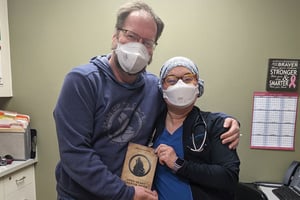
Facing Cancer Like an Engineer: A Problem in Search of Solutions
One Sunday afternoon in March 2021, Brandon Martin, 61, was hanging out in his Thornton apartment when he doubled over with pain.
“All of a sudden I...

A Cyclist’s Long Road to Recovery After Pancreatic Cancer
As a long-distance cyclist, Joseph V. has always maintained his good health. Besides having his tonsils out as a toddler, he had never faced a...

Bile Duct Cancer: One Woman’s Journey with a Rare Disease
On Aug. 20, 2021, Erica Dewire-Arsenault of Parker, Colorado, was having a good day at her job as a medical assistant – until a sudden, strange...

No Known Risk Factors: A Patient’s Journey Through Stage 3 Colon Cancer Treatment
When Dominique Journet was told she had a tumor after a colonoscopy, she was convinced it couldn’t be cancer. She was otherwise healthy with no...

From Colon Polyps to Incurable Cancer to Becoming Cancer Free
It’s been a busy decade for Mark Hoshall. After all, he went from the discovery of colon polyps during a routine colonoscopy to being diagnosed with...

Grammy Winner and Colon Cancer Survivor Returns to Cancer Clinic as a Performer

Colon Cancer Patient Proves ‘Stage Four’ Does Not Mean ‘Terminal’
This Second Opinion is Key to Finding the Right Cancer Care Team